
About this resource
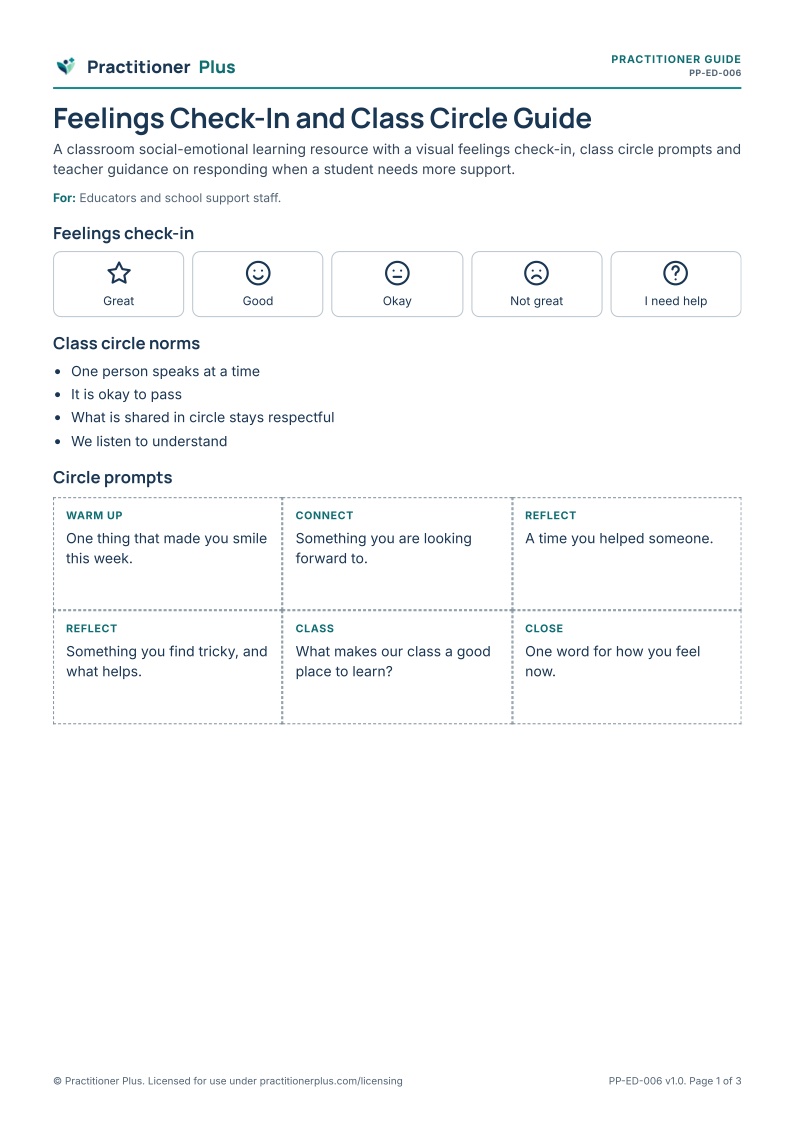
Regular check-ins help students build emotional vocabulary and help teachers notice who might need support. This guide includes a visual feelings check-in, a structure for short class circles with discussion prompts, and guidance on responding privately when a student needs more support.
Purpose
To build a regular, safe routine for noticing feelings and connecting as a class, with clear guidance for following up concerns.
Who it is for
Primary profession: Educators and school support staff.
Client or participant group: Primary and lower secondary classes.
Practice setting: Classroom morning meetings, homeroom and wellbeing lessons.
Suggested uses
- Morning meetings or homeroom
- Wellbeing and social-emotional learning lessons
- Re-connecting after breaks or difficult events
- Building class community
Instructions for practitioners
- Agree class circle norms with students: listen, pass is okay, respect privacy.
- Use the check-in daily or weekly, without requiring students to share publicly.
- Follow up privately with students who seem to be struggling.
- Refer concerns to your school wellbeing team according to school procedures.
Instructions for clients or participants
- Point to or choose how you are feeling.
- Share in the circle if you want to, or pass.
Accessibility considerations
The check-in uses faces and words. Students can respond privately on paper or by pointing. Adapt prompts for age and culture.
Scope and limitations
A general classroom wellbeing activity. It is not a screening tool. Concerns about a student's wellbeing or safety must be followed up under school procedures.
Research basis
School-based social and emotional learning programs improve students' social skills, behaviour and academic results. Understanding, naming and choosing strategies for emotions are central to emotion regulation; putting feelings into words and finer emotion distinctions are linked to better regulation.
- Durlak, J. A., Weissberg, R. P., Dymnicki, A. B., Taylor, R. D., & Schellinger, K. B. (2011). The Impact of Enhancing Students’ Social and Emotional Learning: A Meta-Analysis of School-Based Universal Interventions. Child Development, 82(1), 405–432. https://doi.org/10.1111/j.1467-8624.2010.01564.x
- Gross, J. J. (2015). Emotion Regulation: Current Status and Future Prospects. Psychological Inquiry, 26(1), 1–26. https://doi.org/10.1080/1047840x.2014.940781
- Kashdan, T. B., Barrett, L. F., & McKnight, P. E. (2015). Unpacking Emotion Differentiation: Transforming Unpleasant Experience by Perceiving Distinctions in Negativity. Current Directions in Psychological Science, 24(1), 10–16. https://doi.org/10.1177/0963721414550708
- Kircanski, K., Lieberman, M. D., & Craske, M. G. (2012). Feelings Into Words: Contributions of Language to Exposure Therapy. Psychological Science, 23(10), 1086–1091. https://doi.org/10.1177/0956797612443830
What is included
A 3-page printable A4 PDF, including a practitioner notes page with the research basis (version 1.0).
Originality
Original Practitioner Plus content: wording, activity structure, layout and icons were created for this resource. No third-party worksheets, illustrations or text were reproduced.


