
About this resource
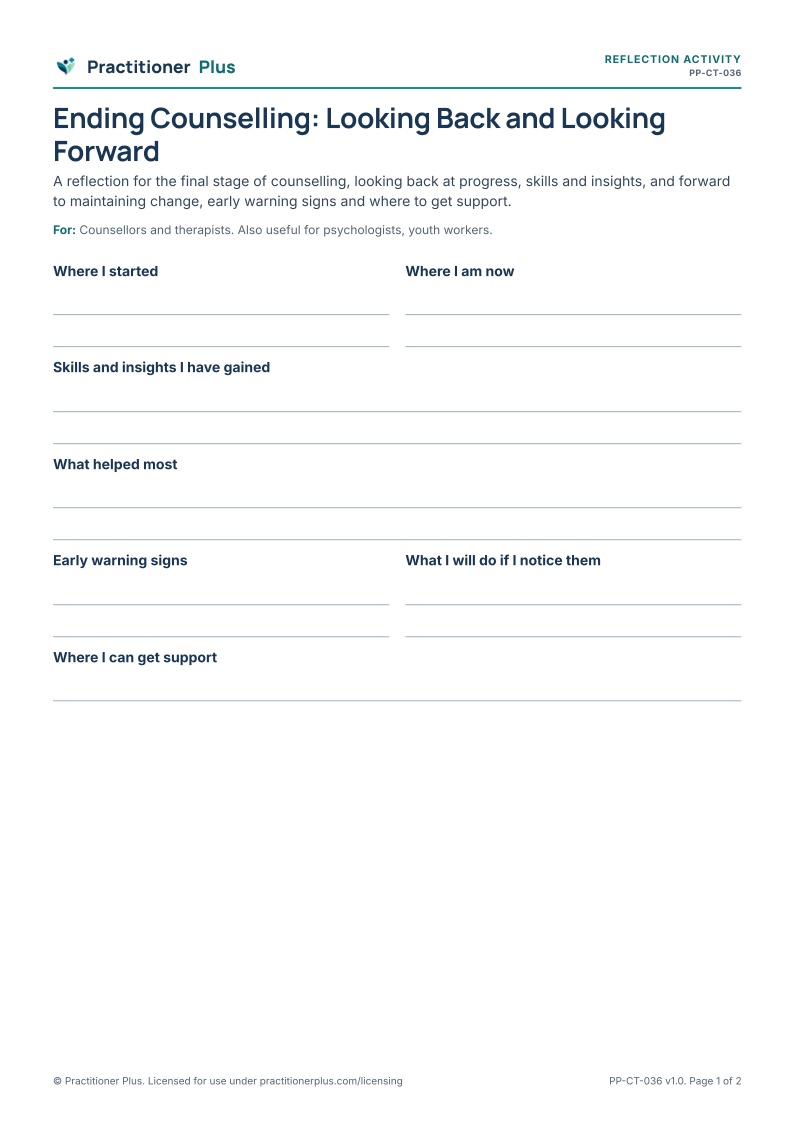
Endings matter. This reflection helps clients look back at where they started, what has changed, the skills and insights they gained and what helped, then look forward to keeping changes going, early warning signs and where to get support if needed.
Purpose
To consolidate learning and plan for the future as counselling ends.
Who it is for
Primary profession: Counsellors and therapists. Also relevant for psychologists, youth workers.
Client or participant group: Adolescents and adults finishing counselling.
Practice setting: The final one or two counselling sessions.
Suggested uses
- Final sessions
- Planned breaks
- Relapse prevention
- Transitions to other services
Instructions for practitioners
- Raise the ending in advance.
- Acknowledge the client's efforts.
- Plan for setbacks without alarm.
- Explain how to return or access support.
Instructions for clients or participants
- Write what has changed.
- Write what helped.
- Plan how you will keep going.
Accessibility considerations
Can be completed verbally or as a drawing.
Scope and limitations
A reflective tool for use within counselling.
Research basis
A strong working alliance and routine progress feedback are among the most consistent predictors of good outcomes in therapy.
- Flückiger, C., Del Re, A. C., Wampold, B. E., & Horvath, A. O. (2018). The alliance in adult psychotherapy: A meta-analytic synthesis. Psychotherapy, 55(4), 316–340. https://doi.org/10.1037/pst0000172
- Lambert, M. J., Whipple, J. L., & Kleinstäuber, M. (2018). Collecting and delivering progress feedback: A meta-analysis of routine outcome monitoring. Psychotherapy, 55(4), 520–537. https://doi.org/10.1037/pst0000167
What is included
A 2-page printable A4 PDF, including a practitioner notes page with the research basis (version 1.0).
Originality
Original Practitioner Plus content: wording, activity structure, layout and icons were created for this resource. No third-party worksheets, illustrations or text were reproduced.


