
About this resource
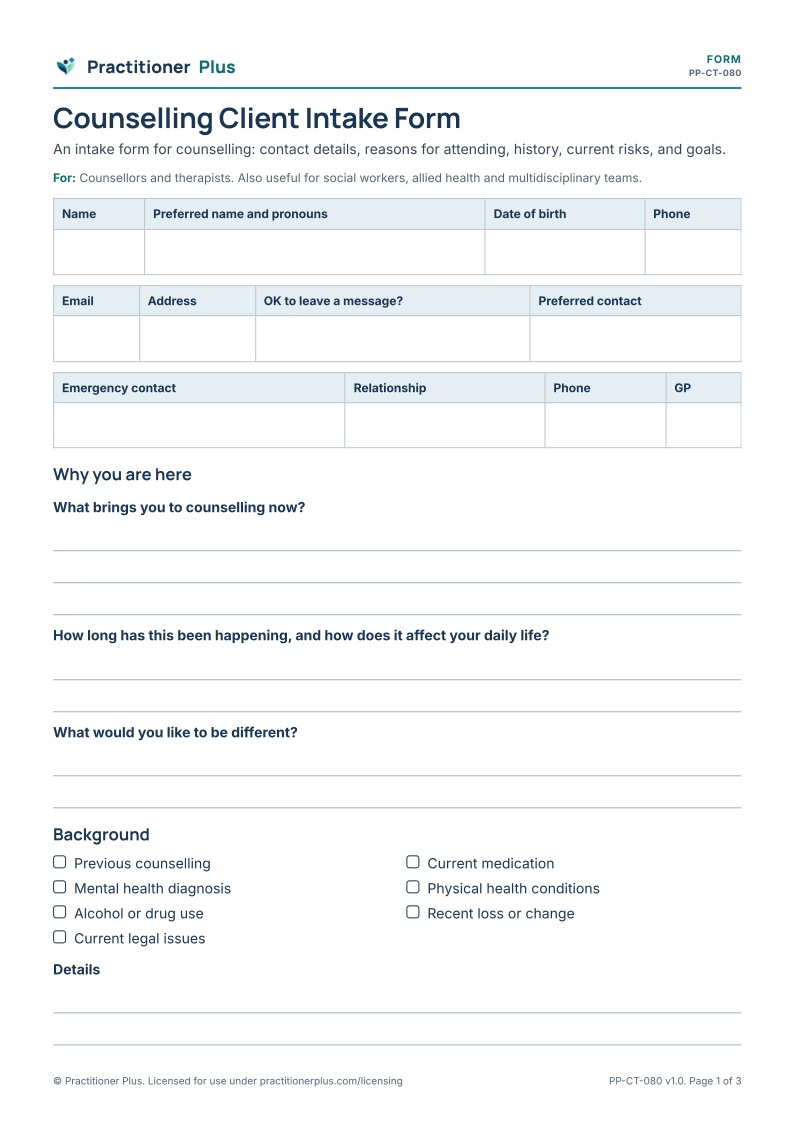
A clear intake form saves time in the first session. This form covers contacts, reasons for attending, history, current supports, safety, and what the person wants to get from counselling.
Purpose
An intake form for counselling: contact details, reasons for attending, history, current risks, and goals.
Who it is for
Primary profession: Counsellors and therapists. Also relevant for social workers, allied health and multidisciplinary teams.
Client or participant group: Practitioners and teams.
Practice setting: Private practice, community and organisational settings.
Suggested uses
- New client pack
- Online intake
- Audit or supervision of your practice
Instructions for practitioners
- Add your details and delete what does not apply.
- Check it against your professional requirements.
- Explain it to the person in plain language.
- Store completed copies securely.
Accessibility considerations
Clear headings and tables. The Word version can be edited and filled in on screen.
Scope and limitations
A template for adaptation. It is not legal advice. Check it against your professional body's requirements, your insurer's advice and the law where you work.
Research basis
Health service providers must handle health information in line with the Privacy Act and Australian Privacy Principles, including telling people what is collected and why, and obtaining consent where required. A strong working alliance and routine progress feedback are among the most consistent predictors of good outcomes in therapy.
- Flückiger, C., Del Re, A. C., Wampold, B. E., & Horvath, A. O. (2018). The alliance in adult psychotherapy: A meta-analytic synthesis. Psychotherapy, 55(4), 316–340. https://doi.org/10.1037/pst0000172
- Lambert, M. J., Whipple, J. L., & Kleinstäuber, M. (2018). Collecting and delivering progress feedback: A meta-analysis of routine outcome monitoring. Psychotherapy, 55(4), 520–537. https://doi.org/10.1037/pst0000167
- Office of the Australian Information Commissioner. Guide to health privacy. https://www.oaic.gov.au/privacy/privacy-guidance-for-organisations-and-government-agencies/health-service-providers/guide-to-health-privacy
What is included
A 3-page printable A4 PDF, including a practitioner notes page with the research basis (version 1.0).
Originality
Original Practitioner Plus content: wording, activity structure, layout and icons were created for this resource. No third-party worksheets, illustrations or text were reproduced. Written for Practitioner Plus from the sources in the research basis.


