
About this resource
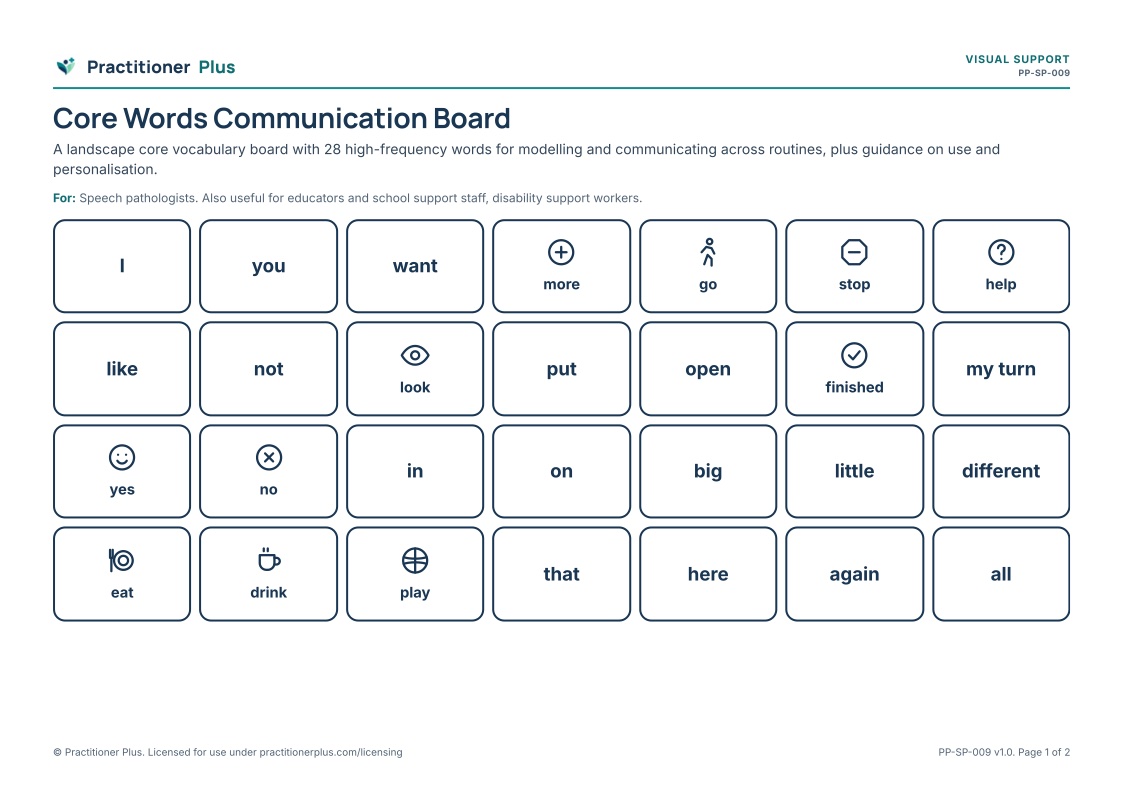
A small set of core words can be combined to say many things across the day. This board includes 28 high-frequency words in a consistent layout, for partners to model and for the person to use, with guidance on modelling, keeping the layout consistent and adding personal words alongside.
Purpose
To provide flexible, high-frequency words that can be used and modelled across many activities.
Who it is for
Primary profession: Speech pathologists. Also relevant for educators and school support staff, disability support workers.
Client or participant group: Children and adults building functional communication, and their communication partners.
Practice setting: Home, classroom, therapy and community settings.
Suggested uses
- Modelling language across routines
- A starting board before a personalised system
- Classroom communication supports
- Combining words into short phrases
Instructions for practitioners
- Model words on the board during everyday activities.
- Keep the layout consistent so the person can learn where words are.
- Add personal and activity-specific words on a separate board.
- Review vocabulary with a speech pathologist.
Instructions for clients or participants
- Point to words to say what you want to say.
Accessibility considerations
Print large, laminate and keep in a consistent place. Match colour coding or symbol systems the person already uses.
Scope and limitations
A general core vocabulary board. It does not replace an AAC assessment or a personalised communication system.
Research basis
Modelling on the person's AAC system (aided language input) improves communication outcomes, especially expressive use, for people with complex communication needs. Visual schedules and other visual supports are established evidence-based practices for autistic children and young people, and are widely used with others who benefit from visual information.
- Biggs, E. E., Carter, E. W., & Gilson, C. B. (2018). Systematic Review of Interventions Involving Aided AAC Modeling for Children With Complex Communication Needs. American Journal on Intellectual and Developmental Disabilities, 123(5), 443–473. https://doi.org/10.1352/1944-7558-123.5.443
- Knight, V., Sartini, E., & Spriggs, A. D. (2015). Evaluating Visual Activity Schedules as Evidence-Based Practice for Individuals with Autism Spectrum Disorders. Journal of Autism and Developmental Disorders, 45(1), 157–178. https://doi.org/10.1007/s10803-014-2201-z
- Sennott, S. C., Light, J. C., & McNaughton, D. (2016). AAC Modeling Intervention Research Review. Research and Practice for Persons with Severe Disabilities, 41(2), 101–115. https://doi.org/10.1177/1540796916638822
- Steinbrenner, J. R., Hume, K., Odom, S. L., Morin, K. L., Nowell, S. W., Tomaszewski, B., Szendrey, S., McIntyre, N. S., Yücesoy-Özkan, S., & Savage, M. N. (2020). Evidence-based practices for children, youth, and young adults with autism. FPG Child Development Institute, University of North Carolina. https://ncaep.fpg.unc.edu/wp-content/uploads/EBP-Report-2020.pdf
What is included
A 2-page printable A4 PDF, including a practitioner notes page with the research basis (version 1.0).
Originality
Original Practitioner Plus content: wording, activity structure, layout and icons were created for this resource. No third-party worksheets, illustrations or text were reproduced. Reflects the widely used concept of core vocabulary; word selection and layout are original.


