
About this resource
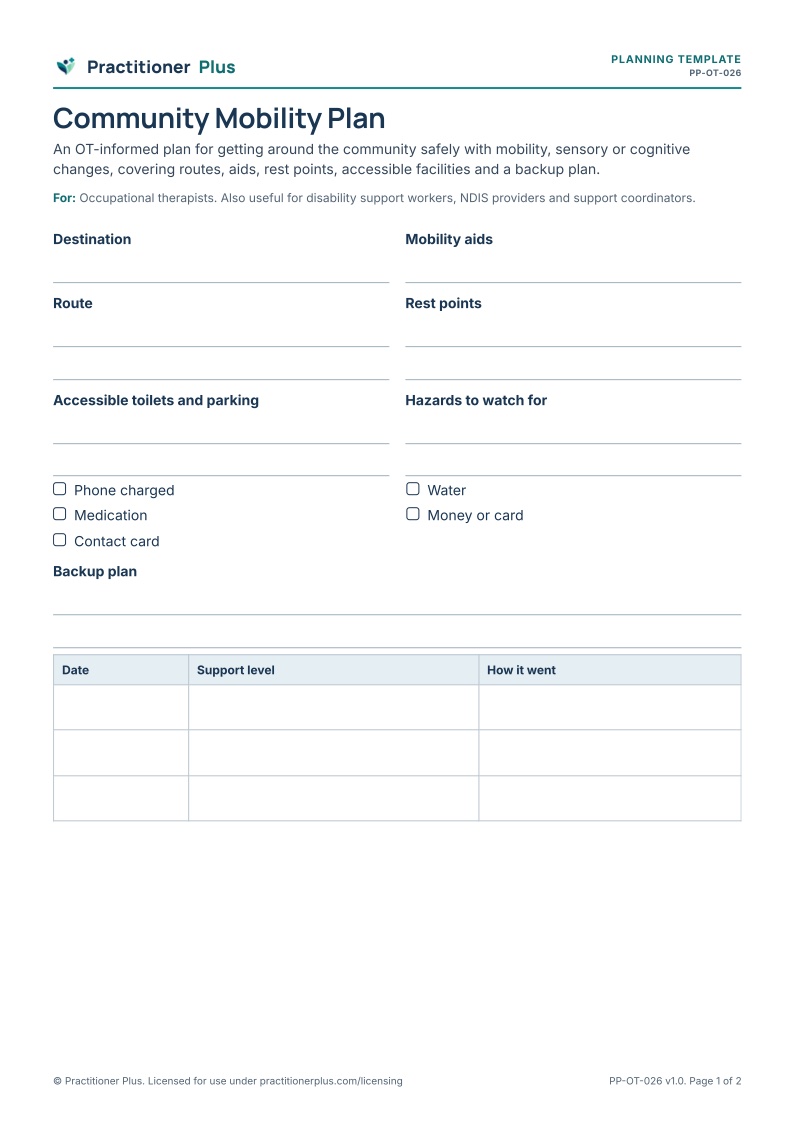
Getting around the community involves more than transport. This plan records the destination, route, mobility aids, rest points, accessible toilets and parking, hazards, what to bring and a backup plan, and tracks practice trips.
Purpose
To plan safe, confident trips in the community.
Who it is for
Primary profession: Occupational therapists. Also relevant for disability support workers, NDIS providers and support coordinators.
Client or participant group: Adults and young people with mobility, sensory or cognitive changes.
Practice setting: Occupational therapy, rehabilitation and community access.
Suggested uses
- Rehabilitation
- Community access goals
- Travel training
- Planning new routes
Instructions for practitioners
- Plan routes with the person and check them in advance where possible.
- Consider fatigue, weather and time of day.
- Practise together before independent trips.
- Review and adjust after each trip.
Instructions for clients or participants
- Plan your route.
- Pack what you need.
- Know your backup plan.
Accessibility considerations
Use maps, photos of landmarks and phone navigation.
Scope and limitations
A planning tool. It does not assess community mobility safety.
Research basis
Occupational therapy models describe how the person, their environment and their activities interact, and how a balance of meaningful activity supports health and participation. Exercise and home hazard reduction both reduce falls in older people living in the community.
- Clemson, L., Mackenzie, L., Ballinger, C., Close, J. C. T., & Cumming, R. G. (2008). Environmental Interventions to Prevent Falls in Community-Dwelling Older People: A Meta-Analysis of Randomized Trials. Journal of Aging and Health, 20(8), 954–971. https://doi.org/10.1177/0898264308324672
- Law, M., Cooper, B., Strong, S., Stewart, D., Rigby, P., & Letts, L. (1996). The Person-Environment-Occupation Model: A Transactive Approach to Occupational Performance. Canadian Journal of Occupational Therapy, 63(1), 9–23. https://doi.org/10.1177/000841749606300103
- Sherrington, C., Fairhall, N. J., Wallbank, G. K., Tiedemann, A., Michaleff, Z. A., Howard, K., Clemson, L., Hopewell, S., & Lamb, S. E. (2019). Exercise for preventing falls in older people living in the community. Cochrane Database of Systematic Reviews, Article CD012424. https://doi.org/10.1002/14651858.cd012424.pub2
- Wagman, P., Håkansson, C., & Björklund, A. (2012). Occupational balance as used in occupational therapy: A concept analysis. Scandinavian Journal of Occupational Therapy, 19(4), 322–327. https://doi.org/10.3109/11038128.2011.596219
- World Health Organization. (2001). International classification of functioning, disability and health (ICF). WHO. https://www.who.int/standards/classifications/international-classification-of-functioning-disability-and-health
What is included
A 2-page printable A4 PDF, including a practitioner notes page with the research basis (version 1.0).
Originality
Original Practitioner Plus content: wording, activity structure, layout and icons were created for this resource. No third-party worksheets, illustrations or text were reproduced.


