
About this resource
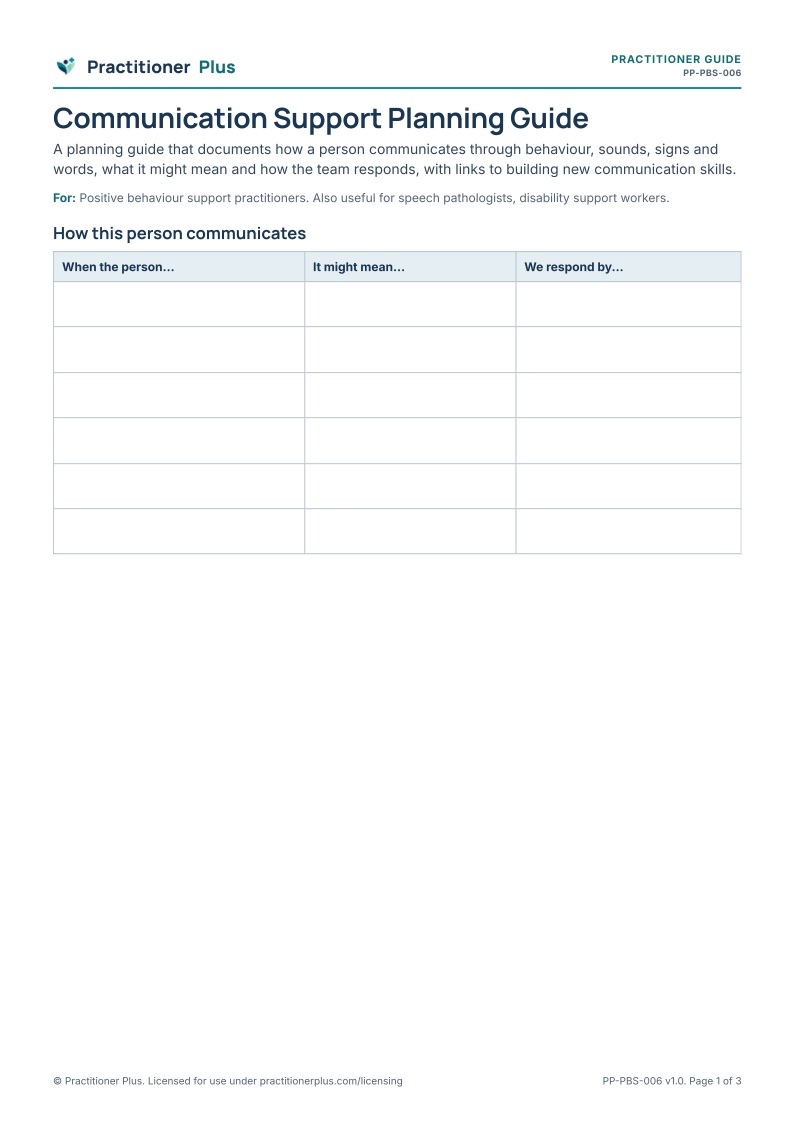
Many behaviours of concern are communication. This guide helps teams document what the person does, what it might mean and how everyone will respond, identify communication skills worth teaching, and adjust the environment so communicating is easier.
Purpose
To help teams recognise and respond consistently to a person's communication, and to support new ways of communicating.
Who it is for
Primary profession: Positive behaviour support practitioners. Also relevant for speech pathologists, disability support workers.
Client or participant group: People who communicate in ways others find hard to understand, and their support teams.
Practice setting: Supported living, school, day programs and family homes, with input from a behaviour support practitioner and speech pathologist.
Suggested uses
- Building a shared understanding of a person's communication
- Onboarding new team members
- Working alongside a speech pathologist on new communication skills
- Reviewing responses after changes in the person's life
Instructions for practitioners
- Gather observations from people who know the person well.
- Record each communication signal, possible meanings and the agreed response.
- Work with a speech pathologist on skills to teach, such as asking for a break or help.
- Keep responses consistent and review regularly.
Accessibility considerations
Use photos or video examples of the person's signals where appropriate and consented. Include the person's own view wherever possible.
Scope and limitations
A general communication planning guide. It is not a behaviour support plan or a communication assessment, and it does not recommend restrictive practices.
Research basis
Positive behaviour support aims to improve quality of life and reduce behaviours of concern by understanding their function and changing environments and skills. Training communication partners improves communication for people who use AAC and people with aphasia.
- Allen, D., James, W., Evans, J., Hawkins, S., & Jenkins, R. (2005). Positive Behavioural Support: Definition, Current Status and Future Directions. Tizard Learning Disability Review, 10(2), 4–11. https://doi.org/10.1108/13595474200500014
- Kent-Walsh, J., Murza, K. A., Malani, M. D., & Binger, C. (2015). Effects of Communication Partner Instruction on the Communication of Individuals using AAC: A Meta-Analysis. Augmentative and Alternative Communication, 31(4), 271–284. https://doi.org/10.3109/07434618.2015.1052153
- NDIS Quality and Safeguards Commission. NDIS Practice Standards and Quality Indicators. https://www.ndiscommission.gov.au/rules-and-standards/ndis-practice-standards
- Simmons-Mackie, N., Raymer, A., & Cherney, L. R. (2016). Communication Partner Training in Aphasia: An Updated Systematic Review. Archives of Physical Medicine and Rehabilitation, 97(12), 2202–2221.e8. https://doi.org/10.1016/j.apmr.2016.03.023
What is included
A 3-page printable A4 PDF, including a practitioner notes page with the research basis (version 1.0).
Originality
Original Practitioner Plus content: wording, activity structure, layout and icons were created for this resource. No third-party worksheets, illustrations or text were reproduced.


