
About this resource
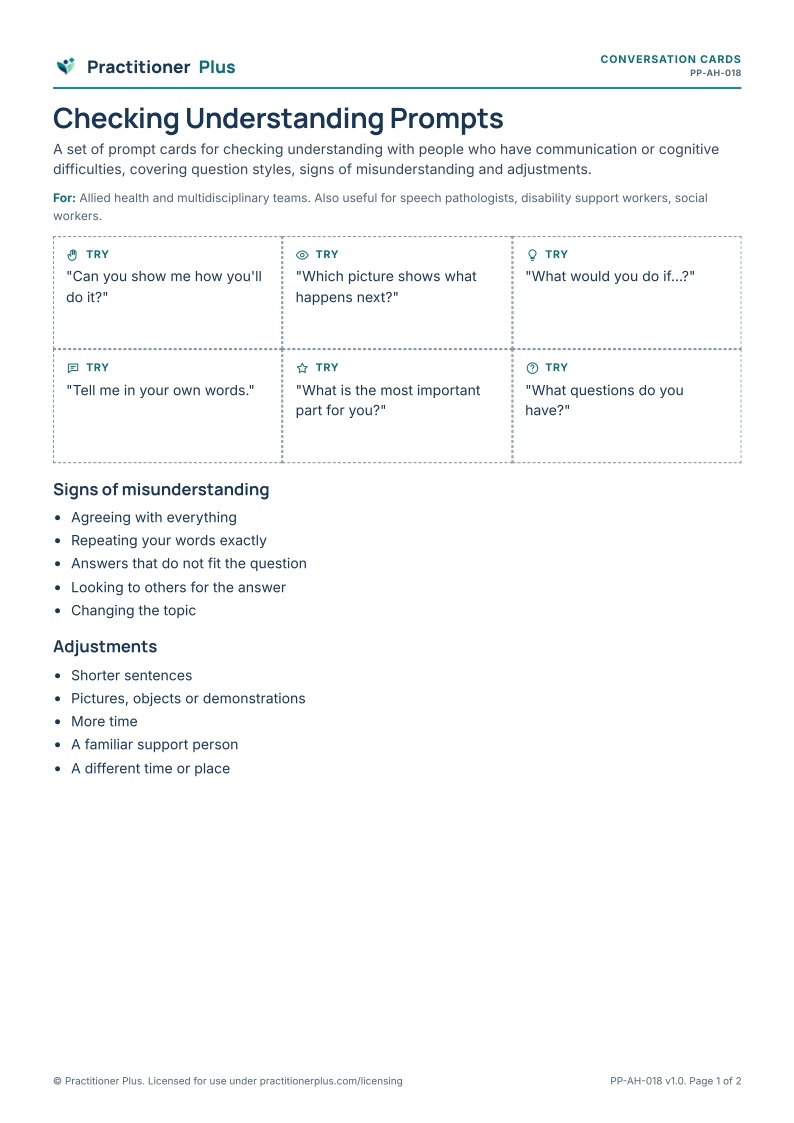
Asking "Do you understand?" usually gets a yes. These prompt cards offer other ways to check understanding, such as show me, choosing between pictures and scenario questions, plus signs the person may not have understood and adjustments that can help.
Purpose
To help practitioners check understanding in ways that suit the person.
Who it is for
Primary profession: Allied health and multidisciplinary teams. Also relevant for speech pathologists, disability support workers, social workers.
Client or participant group: Practitioners working with people who have communication, cognitive or language differences.
Practice setting: Health, disability and community settings, including consent conversations.
Suggested uses
- Consent conversations
- Explaining home programs
- Appointments and assessments
- Team training
Instructions for practitioners
- Choose prompts that suit the person's communication.
- Check understanding of key points only.
- Watch for signs of misunderstanding.
- Involve a speech pathologist for important decisions such as consent.
Accessibility considerations
Cards can be printed and kept on a lanyard or in a folder.
Scope and limitations
Practice prompts. They do not assess decision-making capacity.
Research basis
Clear, plain-language information and checking understanding (teach-back) improve understanding, safety and quality of care.
- Australian Commission on Safety and Quality in Health Care. (2014). Health literacy: Taking action to improve safety and quality. ACSQHC. https://www.safetyandquality.gov.au/publications-and-resources/resource-library/health-literacy-taking-action-improve-safety-and-quality
- Australian Government. Style Manual: Plain language and word choice. https://www.stylemanual.gov.au/writing-and-designing-content/clear-language-and-writing-style/plain-language-and-word-choice
- Talevski, J., Wong Shee, A., Rasmussen, B., Kemp, G., & Beauchamp, A. (2020). Teach-back: A systematic review of implementation and impacts. PLOS ONE, 15(4), e0231350. https://doi.org/10.1371/journal.pone.0231350
What is included
A 2-page printable A4 PDF, including a practitioner notes page with the research basis (version 1.0).
Originality
Original Practitioner Plus content: wording, activity structure, layout and icons were created for this resource. No third-party worksheets, illustrations or text were reproduced.


