
About this resource
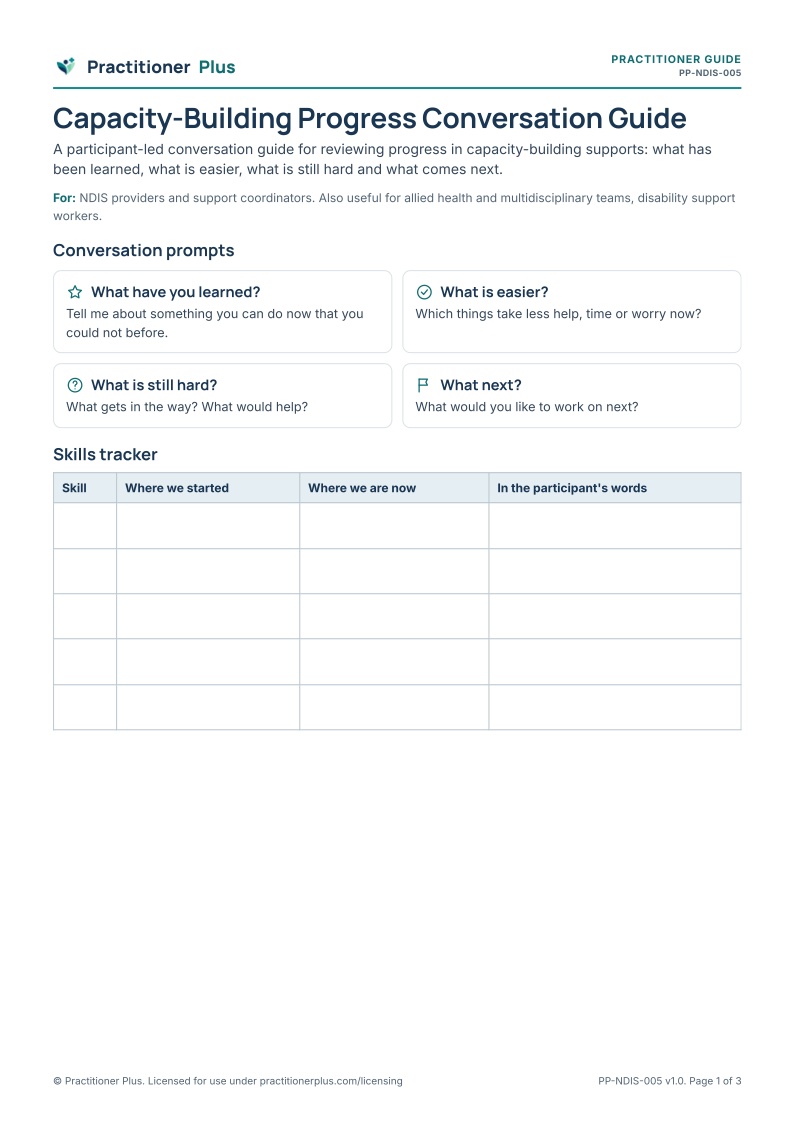
Capacity-building supports aim to grow skills and independence over time. This guide structures regular progress conversations around the participant's own experience: what they have learned, what is easier now, what is still hard and what they want to focus on next, with a simple skills tracker.
Purpose
To make progress conversations participant-led and to capture progress in the participant's own words.
Who it is for
Primary profession: NDIS providers and support coordinators. Also relevant for allied health and multidisciplinary teams, disability support workers.
Client or participant group: NDIS participants receiving capacity-building supports, and the providers delivering them.
Practice setting: Regular progress check-ins between participants and capacity-building providers.
Suggested uses
- Regular progress check-ins
- Preparing information for plan reviews
- Adjusting supports when progress stalls
- Celebrating achievements with the participant
Instructions for practitioners
- Agree how often progress conversations will happen.
- Ask the participant's view first, using open questions and visuals.
- Record progress in the participant's words alongside your observations.
- Agree next steps together.
- Check any reporting against current NDIS requirements and your organisation's templates.
Instructions for clients or participants
- Think about what is easier now.
- Say what is still hard.
- Choose what to work on next.
Accessibility considerations
Use visual scales, photos or videos of skills in action, and the participant's preferred communication. Offer summaries in Easy Read.
Scope and limitations
A conversation guide. It is not an official NDIS progress report template and does not on its own meet any reporting requirement.
Research basis
The strengths model, a recovery-oriented approach, builds on people's own abilities, interests and resources. Specific goals, if-then plans and regular progress monitoring all improve the chances of reaching goals.
- Gollwitzer, P. M., & Sheeran, P. (2006). Implementation Intentions and Goal Achievement: A Meta‐analysis of Effects and Processes. Advances in Experimental Social Psychology, 69–119. https://doi.org/10.1016/s0065-2601(06)38002-1
- Harkin, B., Webb, T. L., Chang, B. P. I., Prestwich, A., Conner, M., Kellar, I., Benn, Y., & Sheeran, P. (2016). Does monitoring goal progress promote goal attainment? A meta-analysis of the experimental evidence. Psychological Bulletin, 142(2), 198–229. https://doi.org/10.1037/bul0000025
- Locke, E. A., & Latham, G. P. (2002). Building a practically useful theory of goal setting and task motivation: A 35-year odyssey. American Psychologist, 57(9), 705–717. https://doi.org/10.1037/0003-066x.57.9.705
- Rapp, C. A., & Goscha, R. J. (2012). The strengths model: A recovery-oriented approach to mental health services (3rd ed.). Oxford University Press.
What is included
A 3-page printable A4 PDF, including a practitioner notes page with the research basis (version 1.0).
Originality
Original Practitioner Plus content: wording, activity structure, layout and icons were created for this resource. No third-party worksheets, illustrations or text were reproduced.


