
About this resource
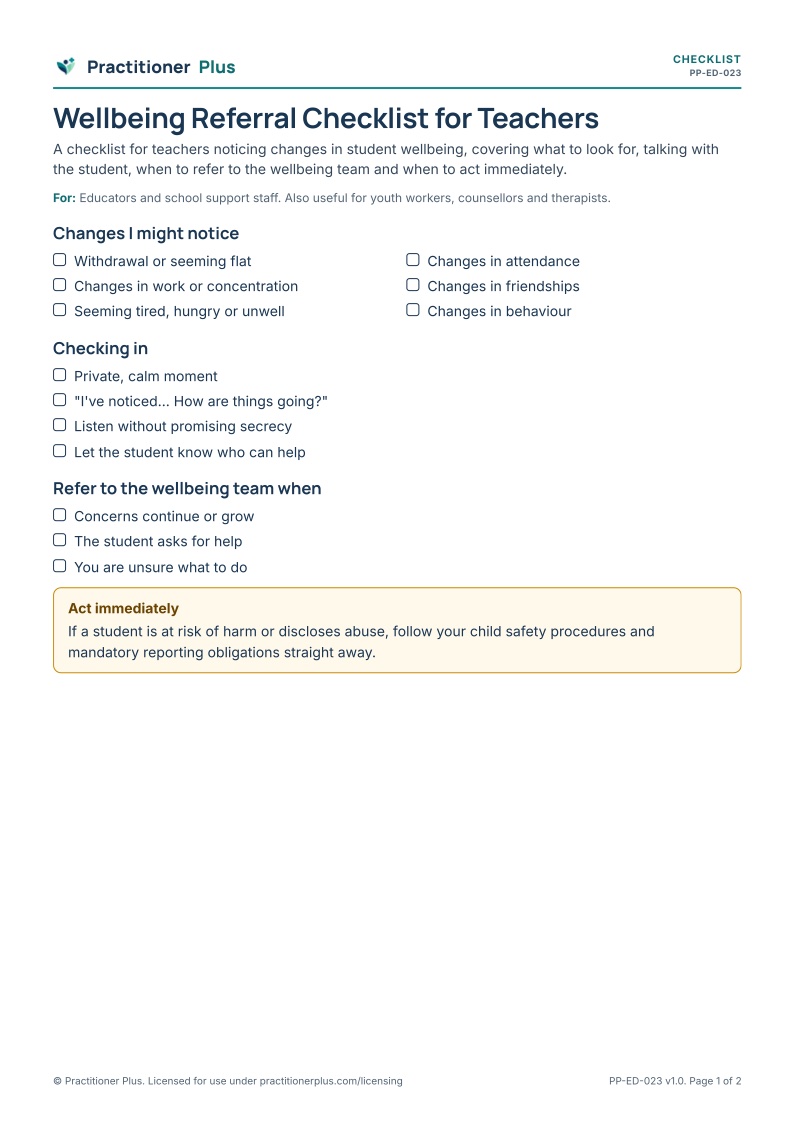
Teachers often notice changes first. This checklist covers signs to look for, how to check in with the student, when and how to refer to the school wellbeing team and when to act immediately under child safety and mandatory reporting obligations.
Purpose
To help teachers respond early and appropriately to student wellbeing concerns.
Who it is for
Primary profession: Educators and school support staff. Also relevant for youth workers, counsellors and therapists.
Client or participant group: Teachers and school staff.
Practice setting: Primary and secondary schools.
Suggested uses
- Staff professional learning
- Day-to-day reference
- Wellbeing team processes
- Graduate teacher support
Instructions for practitioners
- Follow your school's wellbeing referral process.
- Act immediately on risk of harm, following child safety procedures.
- Know your mandatory reporting obligations in your state or territory.
- Record concerns factually.
Accessibility considerations
Editable HTML source available for adaptation to school processes.
Scope and limitations
A practice checklist. It does not replace school policies, child safety procedures or mandatory reporting obligations.
Research basis
Young people are more likely to seek help when they know where to go, trust the person and feel less stigma.
- Rickwood, D., Deane, F. P., Wilson, C. J., & Ciarrochi, J. (2005). Young people’s help-seeking for mental health problems. Australian e-Journal for the Advancement of Mental Health, 4(3), 218–251. https://doi.org/10.5172/jamh.4.3.218
What is included
A 2-page printable A4 PDF, including a practitioner notes page with the research basis (version 1.0).
Originality
Original Practitioner Plus content: wording, activity structure, layout and icons were created for this resource. No third-party worksheets, illustrations or text were reproduced.


