
About this resource
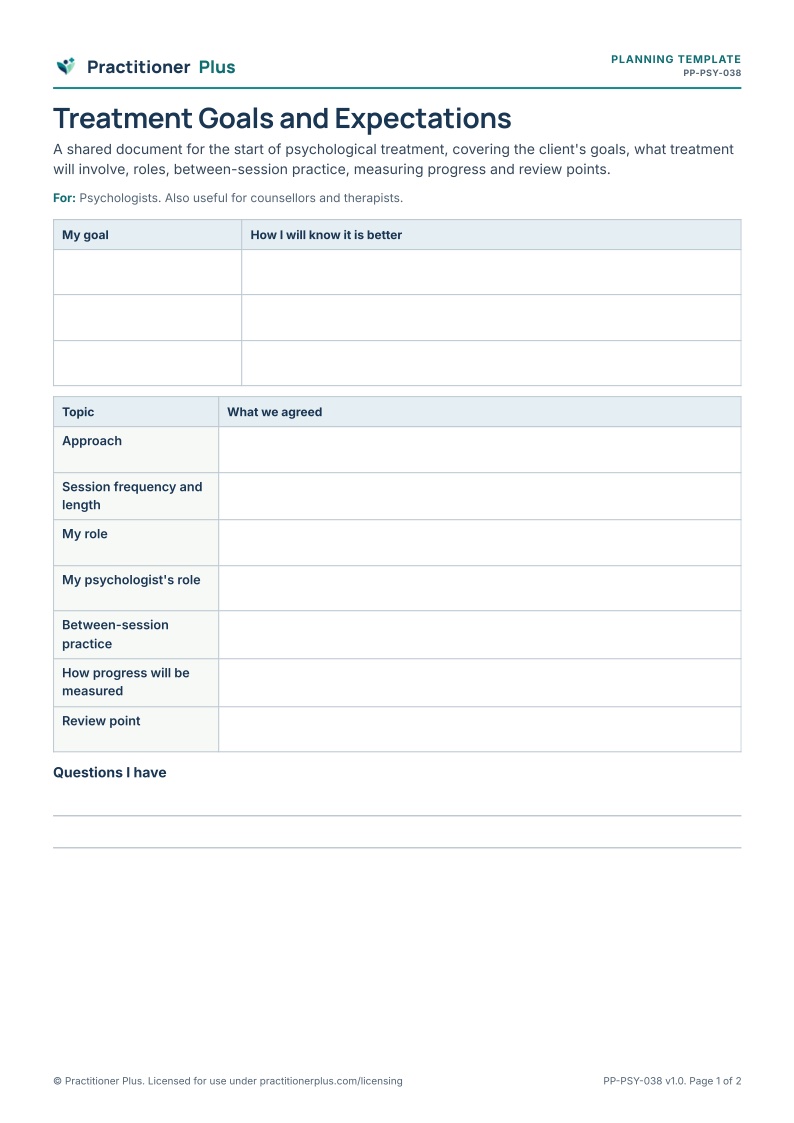
Clear expectations support engagement. This document records the client's goals, the approach and what sessions will involve, roles of client and psychologist, between-session practice, how progress will be measured and when treatment will be reviewed.
Purpose
To build shared understanding and realistic expectations about treatment.
Who it is for
Primary profession: Psychologists. Also relevant for counsellors and therapists.
Client or participant group: Adolescents and adults starting psychological treatment.
Practice setting: Early psychology sessions.
Suggested uses
- Starting treatment
- Reviewing treatment
- Informed consent conversations
- Supporting engagement
Instructions for practitioners
- Complete collaboratively.
- Explain the approach in plain language.
- Discuss the number and frequency of sessions realistically.
- Review at agreed points.
Instructions for clients or participants
- Write your goals.
- Ask questions about treatment.
- Agree review points.
Accessibility considerations
Plain language. Offer interpreters.
Scope and limitations
A planning document. It does not replace informed consent processes.
Research basis
A strong working alliance and routine progress feedback are among the most consistent predictors of good outcomes in therapy. Specific goals, if-then plans and regular progress monitoring all improve the chances of reaching goals.
- Flückiger, C., Del Re, A. C., Wampold, B. E., & Horvath, A. O. (2018). The alliance in adult psychotherapy: A meta-analytic synthesis. Psychotherapy, 55(4), 316–340. https://doi.org/10.1037/pst0000172
- Gollwitzer, P. M., & Sheeran, P. (2006). Implementation Intentions and Goal Achievement: A Meta‐analysis of Effects and Processes. Advances in Experimental Social Psychology, 69–119. https://doi.org/10.1016/s0065-2601(06)38002-1
- Harkin, B., Webb, T. L., Chang, B. P. I., Prestwich, A., Conner, M., Kellar, I., Benn, Y., & Sheeran, P. (2016). Does monitoring goal progress promote goal attainment? A meta-analysis of the experimental evidence. Psychological Bulletin, 142(2), 198–229. https://doi.org/10.1037/bul0000025
- Lambert, M. J., Whipple, J. L., & Kleinstäuber, M. (2018). Collecting and delivering progress feedback: A meta-analysis of routine outcome monitoring. Psychotherapy, 55(4), 520–537. https://doi.org/10.1037/pst0000167
- Locke, E. A., & Latham, G. P. (2002). Building a practically useful theory of goal setting and task motivation: A 35-year odyssey. American Psychologist, 57(9), 705–717. https://doi.org/10.1037/0003-066x.57.9.705
What is included
A 2-page printable A4 PDF, including a practitioner notes page with the research basis (version 1.0).
Originality
Original Practitioner Plus content: wording, activity structure, layout and icons were created for this resource. No third-party worksheets, illustrations or text were reproduced.


