
About this resource
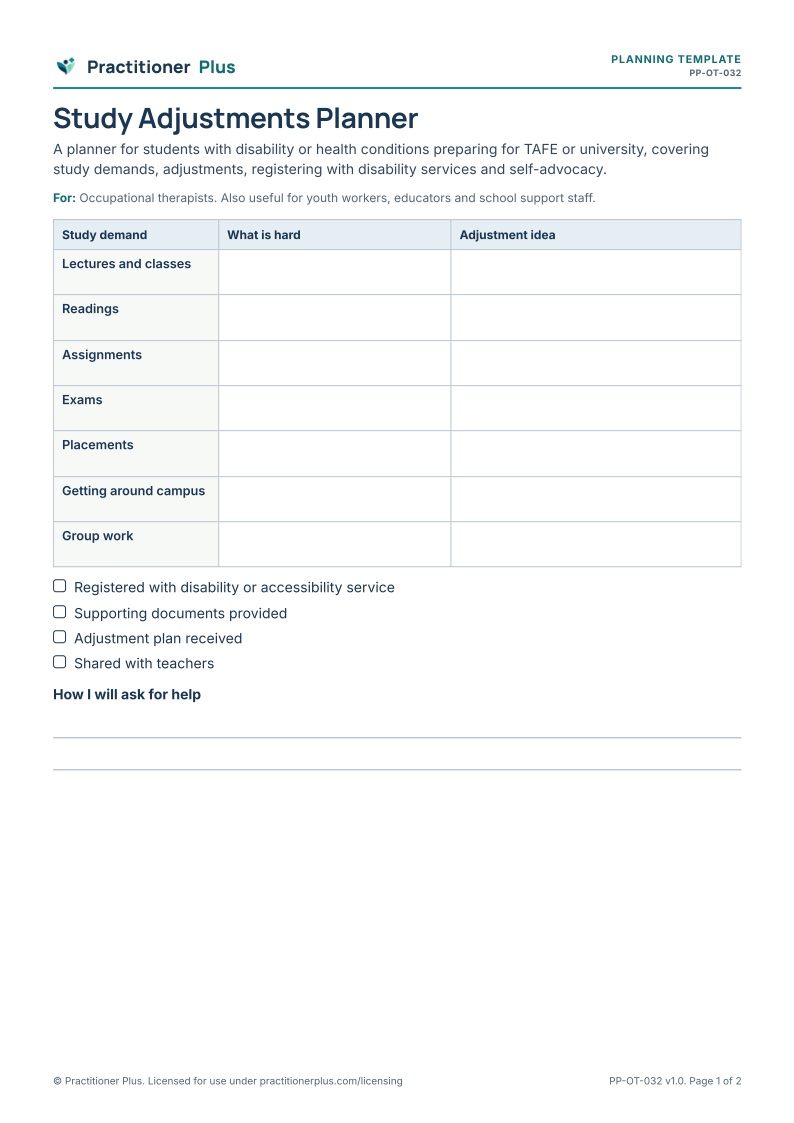
Further study brings new demands. This planner helps students map study demands such as lectures, assessments, placements and exams, identify adjustments, prepare to register with the institution's disability or accessibility service, and practise self-advocacy.
Purpose
To help students identify and request study adjustments.
Who it is for
Primary profession: Occupational therapists. Also relevant for youth workers, educators and school support staff.
Client or participant group: Young people and adults with disability or health conditions entering further study.
Practice setting: Occupational therapy, transition planning and tertiary disability services.
Suggested uses
- Transition from school
- Return to study
- Occupational therapy goals
- Disability service registration
Instructions for practitioners
- Start with the student's course and goals.
- Focus on functional impacts and practical adjustments.
- Help gather supporting documentation.
- Practise asking for adjustments.
Instructions for clients or participants
- Write your course demands.
- Choose adjustments that would help.
- Register with your institution's disability service.
Accessibility considerations
Complete with the student in their preferred format.
Scope and limitations
A planning tool. Institutions have their own processes and documentation requirements.
Research basis
Practice testing and spaced study are among the most effective learning strategies, and self-regulated learning skills can be taught. Clear expectations, explicit teaching of routines and frequent positive feedback are evidence-based classroom practices; adjustments for students with disability are required under the Disability Standards for Education.
- Australian Government. Disability Standards for Education 2005. https://www.education.gov.au/disability-standards-education-2005
- Dunlosky, J., Rawson, K. A., Marsh, E. J., Nathan, M. J., & Willingham, D. T. (2013). Improving Students’ Learning With Effective Learning Techniques: Promising Directions From Cognitive and Educational Psychology. Psychological Science in the Public Interest, 14(1), 4–58. https://doi.org/10.1177/1529100612453266
- Simonsen, B., Fairbanks, S., Briesch, A., Myers, D., & Sugai, G. (2008). Evidence-based practices in classroom management: Considerations for research to practice. Education and Treatment of Children, 31, 351–380. https://doi.org/10.1353/etc.0.0007
- Zimmerman, B. J. (2002). Becoming a Self-Regulated Learner: An Overview. Theory Into Practice, 41(2), 64–70. https://doi.org/10.1207/s15430421tip4102_2
What is included
A 2-page printable A4 PDF, including a practitioner notes page with the research basis (version 1.0).
Originality
Original Practitioner Plus content: wording, activity structure, layout and icons were created for this resource. No third-party worksheets, illustrations or text were reproduced.


