
About this resource
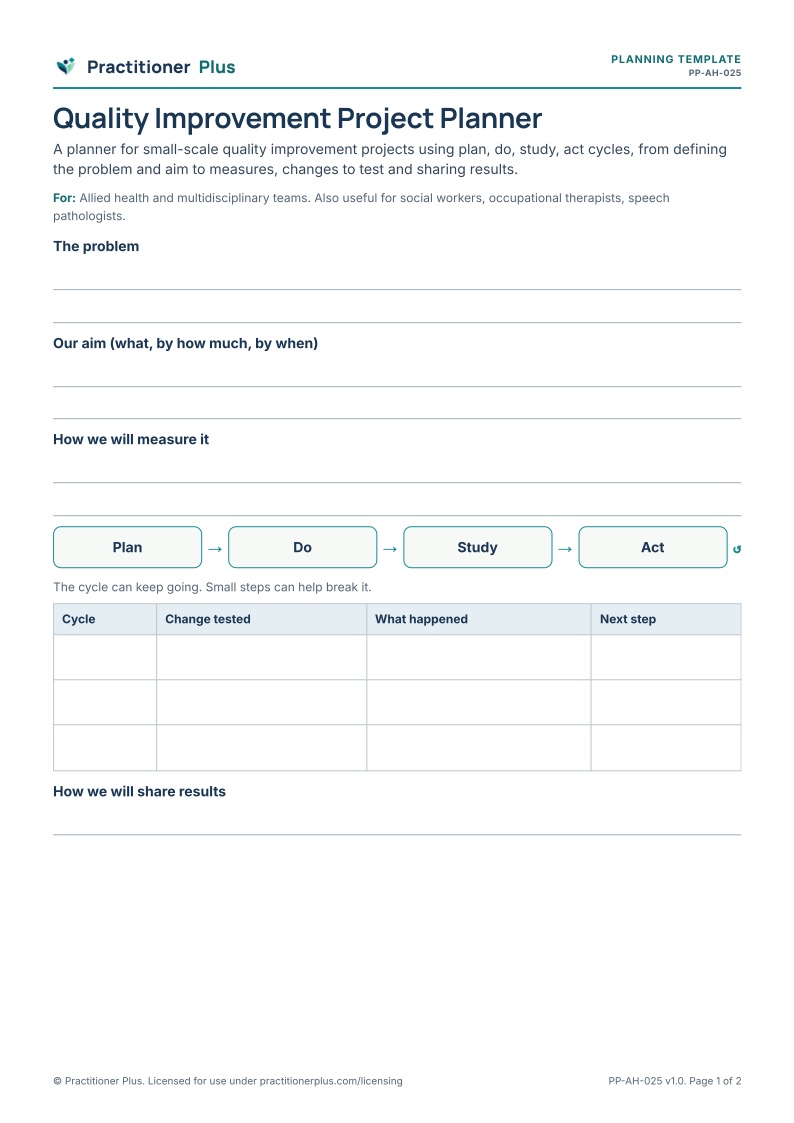
Small, tested changes can improve services. This planner guides teams through defining the problem, setting an aim, choosing measures, planning a change to test, running plan, do, study, act cycles and sharing what they learn.
Purpose
To help teams plan and test practical improvements.
Who it is for
Primary profession: Allied health and multidisciplinary teams. Also relevant for social workers, occupational therapists, speech pathologists.
Client or participant group: Allied health teams and practitioners.
Practice setting: Service quality improvement.
Suggested uses
- Team quality improvement projects
- Professional development
- Student projects
- Service reviews
Instructions for practitioners
- Involve clients and staff who experience the problem.
- Start small and test quickly.
- Measure before and after.
- Share learning, including what did not work.
Accessibility considerations
Editable HTML source available for adaptation.
Scope and limitations
A planning template. Check whether your project needs ethics or governance approval.
Research basis
Clinical supervision and structured reflection support learning, safe practice and professional development.
- Gibbs, G. (1988). Learning by doing: A guide to teaching and learning methods. Further Education Unit, Oxford Polytechnic. https://thoughtsmostlyaboutlearning.files.wordpress.com/2015/12/learning-by-doing-graham-gibbs.pdf
- Milne, D. (2007). An empirical definition of clinical supervision. British Journal of Clinical Psychology, 46(4), 437–447. https://doi.org/10.1348/014466507x197415
What is included
A 2-page printable A4 PDF, including a practitioner notes page with the research basis (version 1.0).
Originality
Original Practitioner Plus content: wording, activity structure, layout and icons were created for this resource. No third-party worksheets, illustrations or text were reproduced. Reflects the widely used plan, do, study, act improvement cycle.


