
About this resource
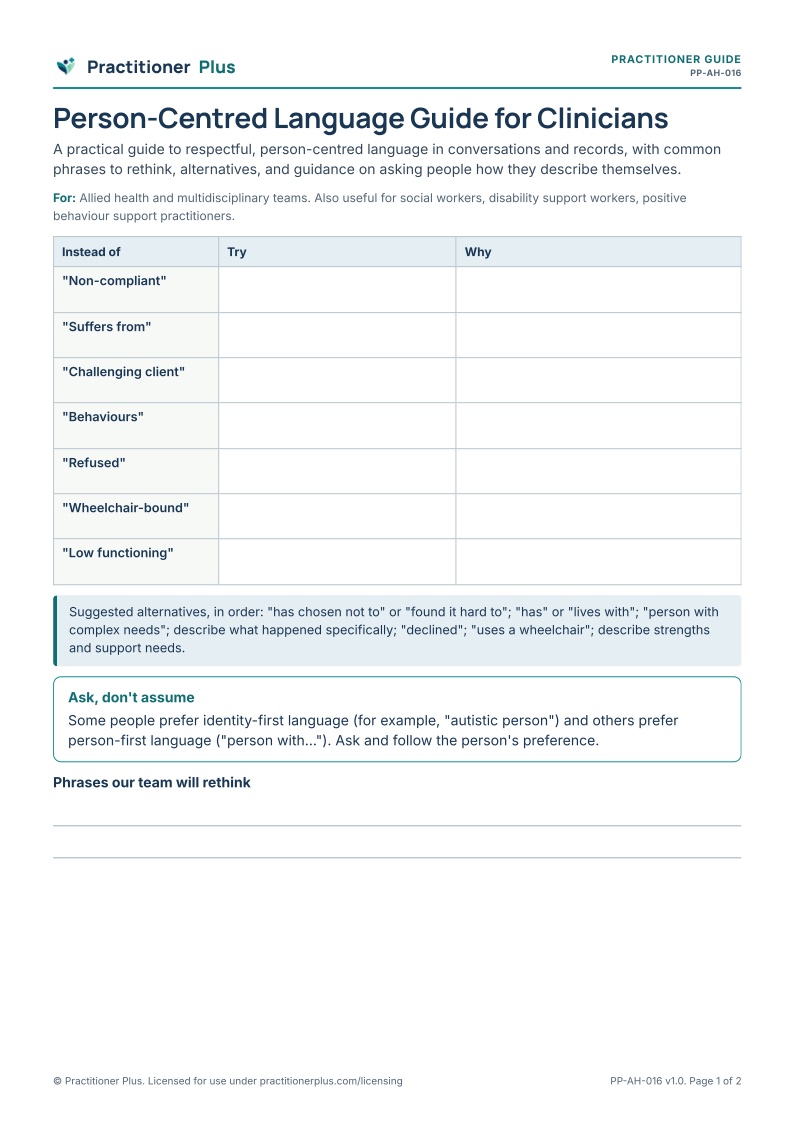
Words shape how people are seen and treated. This guide offers common phrases to rethink, with more respectful and specific alternatives, and guidance on asking people how they describe themselves, including respecting identity-first or person-first preferences.
Purpose
To support respectful language that reflects the person, not just their diagnosis or behaviour.
Who it is for
Primary profession: Allied health and multidisciplinary teams. Also relevant for social workers, disability support workers, positive behaviour support practitioners.
Client or participant group: Allied health and multidisciplinary teams.
Practice setting: Clinical documentation, team meetings, reports and everyday conversations.
Suggested uses
- Documentation training
- Team reflection
- Student and new graduate orientation
- Reviewing reports before sending
Instructions for practitioners
- Ask people how they describe themselves and their experiences.
- Be specific and describe what happened rather than labels.
- Write as if the person will read it, because they may.
- Review team templates for language.
Accessibility considerations
Editable HTML source available for adaptation.
Scope and limitations
A practice guide. Language preferences vary between people and communities; the person's preference comes first.
Research basis
Human rights frameworks and research on the dignity of risk support people's right to make their own choices, including choices that involve some risk. The strengths model, a recovery-oriented approach, builds on people's own abilities, interests and resources.
- Ibrahim, J. E., & Davis, M. (2013). Impediments to applying the ‘dignity of risk’ principle in residential aged care services. Australasian Journal on Ageing, 32(3), 188–193. https://doi.org/10.1111/ajag.12014
- Rapp, C. A., & Goscha, R. J. (2012). The strengths model: A recovery-oriented approach to mental health services (3rd ed.). Oxford University Press.
- United Nations. (2006). Convention on the Rights of Persons with Disabilities. https://www.ohchr.org/en/instruments-mechanisms/instruments/convention-rights-persons-disabilities
What is included
A 2-page printable A4 PDF, including a practitioner notes page with the research basis (version 1.0).
Originality
Original Practitioner Plus content: wording, activity structure, layout and icons were created for this resource. No third-party worksheets, illustrations or text were reproduced.


