
About this resource
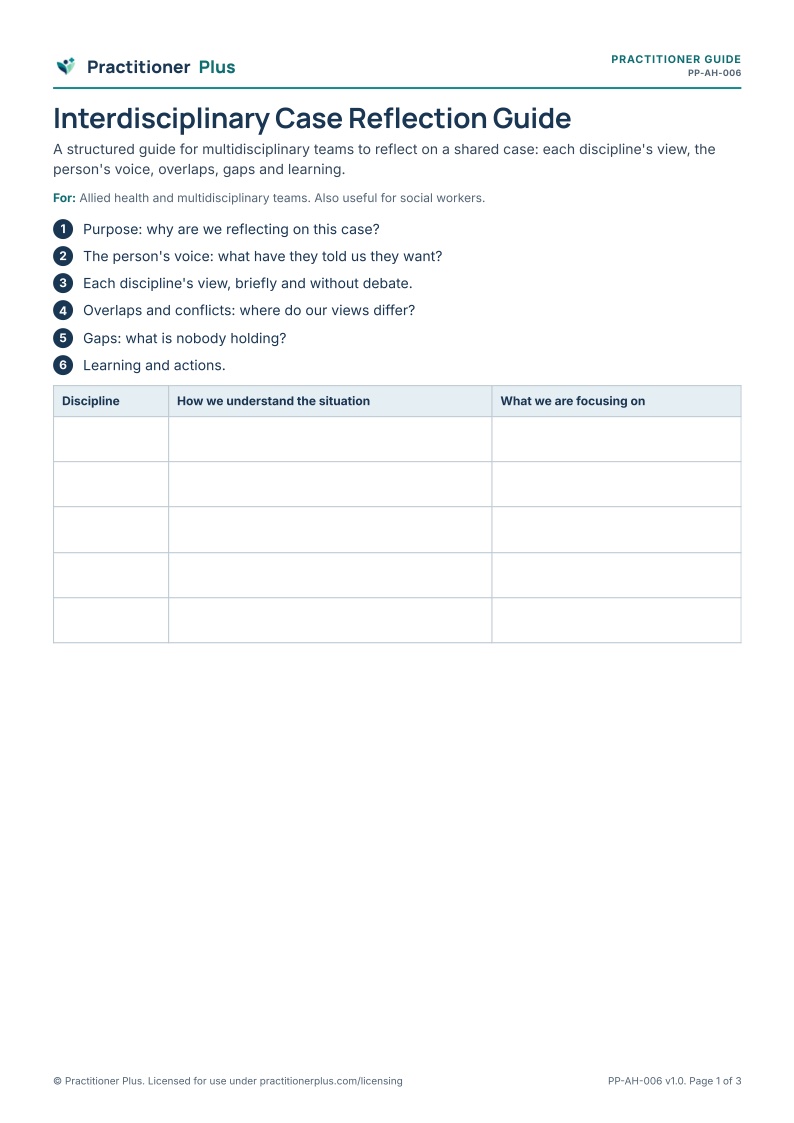
Teams can work hard without seeing the whole picture. This guide structures a reflective discussion: how each discipline understands the situation, what the person has said they want, where views overlap or conflict, what gaps exist and what the team will do differently.
Purpose
To help teams step back from day-to-day work, integrate perspectives and improve coordination around the person.
Who it is for
Primary profession: Allied health and multidisciplinary teams. Also relevant for social workers.
Client or participant group: Multidisciplinary teams in health, disability and community services.
Practice setting: Team reflection meetings, case review and peer supervision.
Suggested uses
- Complex case reviews
- Peer supervision for teams
- Reviewing after a difficult episode of care
- Training in collaborative practice
Instructions for practitioners
- Choose a facilitator and agree the purpose of the reflection.
- Start with the person's own words and goals.
- Invite each discipline to share its view briefly, without debate.
- Explore overlaps, conflicts and gaps.
- Agree learning and actions, and how they will be shared.
Accessibility considerations
Keep the person's voice central by sharing their words and preferences. Use de-identified information where appropriate.
Scope and limitations
A reflective practice guide. It does not replace clinical governance, incident review or supervision requirements.
Research basis
Interprofessional collaboration interventions may improve professional practice and outcomes, although the evidence is still limited.
- Reeves, S., Pelone, F., Harrison, R., Goldman, J., & Zwarenstein, M. (2017). Interprofessional collaboration to improve professional practice and healthcare outcomes. Cochrane Database of Systematic Reviews, Article CD000072. https://doi.org/10.1002/14651858.cd000072.pub3
What is included
A 3-page printable A4 PDF, including a practitioner notes page with the research basis (version 1.0).
Originality
Original Practitioner Plus content: wording, activity structure, layout and icons were created for this resource. No third-party worksheets, illustrations or text were reproduced.


