
About this resource
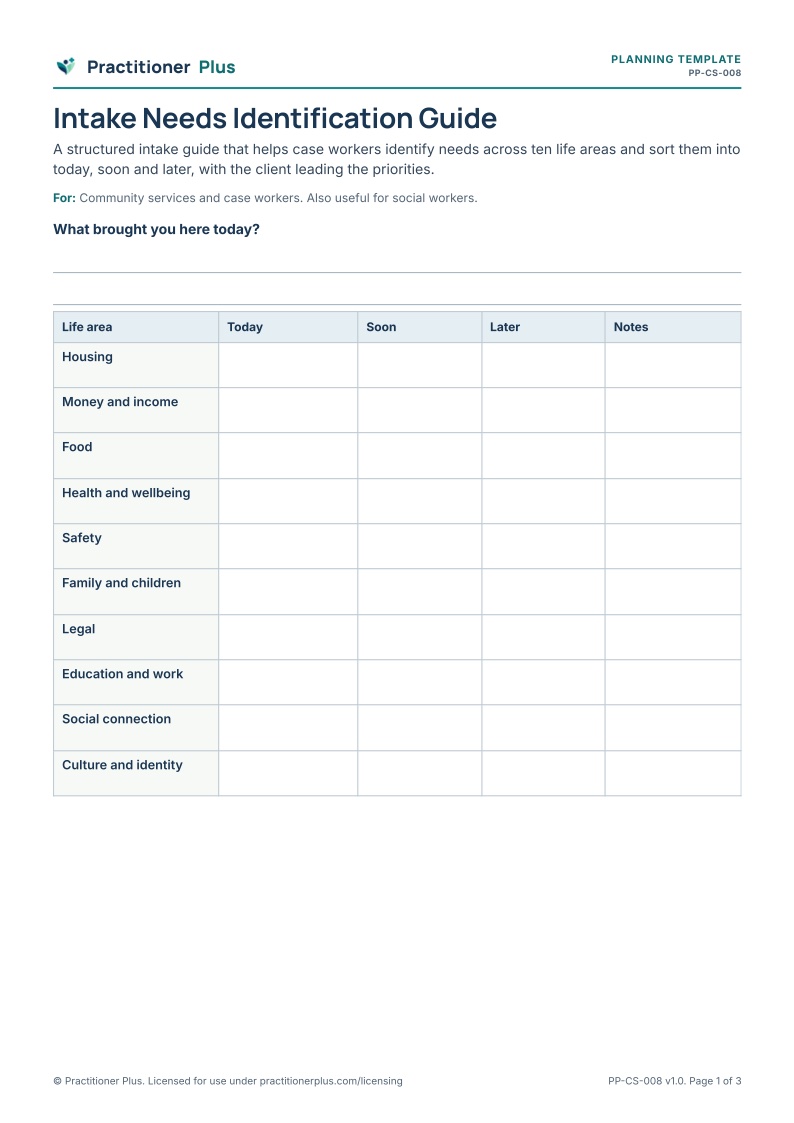
Intake conversations can uncover many needs at once. This guide prompts across ten life areas, helps the client and worker sort needs into what must happen today, soon and later, and records the client's own priorities alongside immediate safety needs.
Purpose
To identify needs quickly and respectfully, and to agree priorities with the client.
Who it is for
Primary profession: Community services and case workers. Also relevant for social workers.
Client or participant group: Adults and families at intake to a community service.
Practice setting: Community services, emergency relief, homelessness and family support intake.
Suggested uses
- Intake and first appointments
- Emergency relief and crisis response
- Reassessing needs at review
- Training new intake workers
Instructions for practitioners
- Ask the client what brought them in, before working through the life areas.
- Use the areas as prompts, not a script, and skip what is not relevant.
- Sort needs into today, soon and later with the client.
- Respond to any immediate safety needs according to your procedures.
- Agree next steps and referrals.
Accessibility considerations
Use plain language and interpreters. Allow the client to decline any area.
Scope and limitations
An intake guide. It does not replace your organisation's intake, risk or safeguarding procedures.
Research basis
Biopsychosocial and ecological models describe how health, relationships and wider systems interact in a person's life. Case management practice standards describe assessment, planning, coordination, review and planned exits with the person at the centre.
- Bronfenbrenner, U. (1979). The Ecology of Human Development: Experiments by Nature and Design. Harvard University Press. https://doi.org/10.4159/9780674028845
- Case Management Society of Australia and New Zealand. (2013). National standards of practice for case management (3rd ed.). https://www.cmsa.org.au/
- Engel, G. L. (1977). The Need for a New Medical Model: A Challenge for Biomedicine. Science, 196(4286), 129–136. https://doi.org/10.1126/science.847460
What is included
A 3-page printable A4 PDF, including a practitioner notes page with the research basis (version 1.0).
Originality
Original Practitioner Plus content: wording, activity structure, layout and icons were created for this resource. No third-party worksheets, illustrations or text were reproduced.


