
About this resource
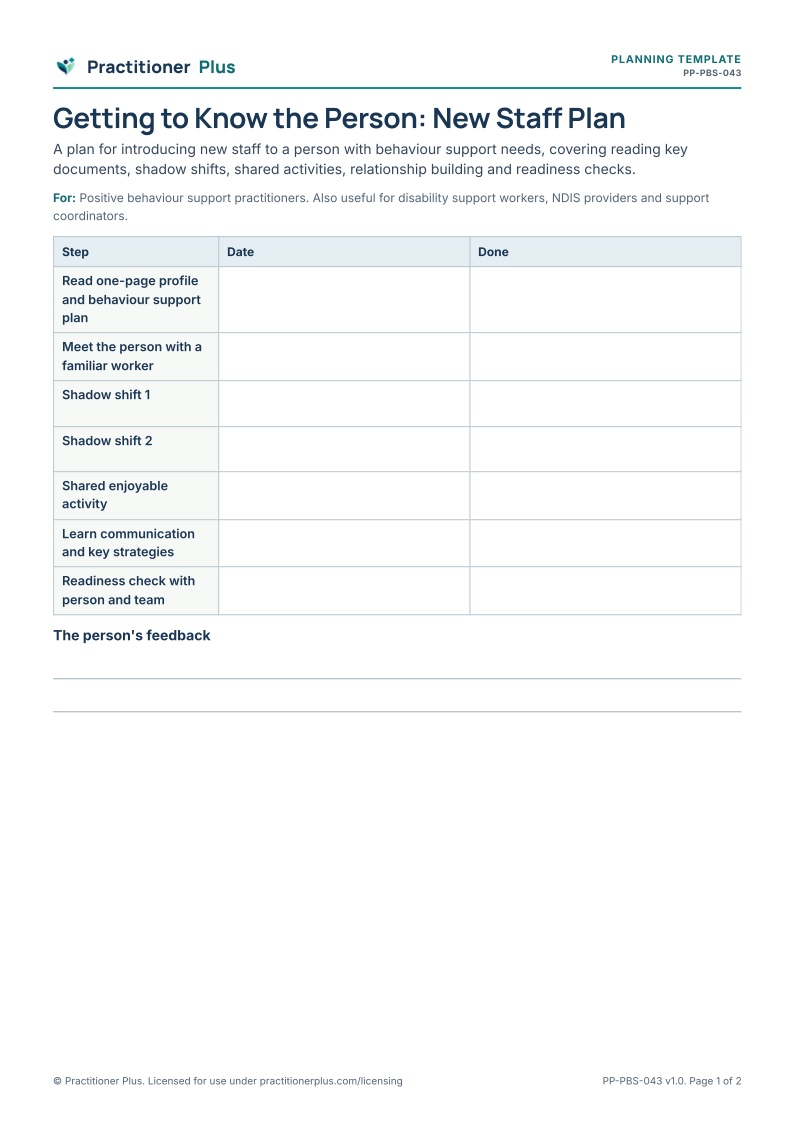
Relationships come first. This plan sets out how new staff will get to know the person: reading the profile and plan, shadow shifts, shared enjoyable activities, learning communication and strategies, and checking readiness with the person and team.
Purpose
To build relationships and consistency before new staff work alone with the person.
Who it is for
Primary profession: Positive behaviour support practitioners. Also relevant for disability support workers, NDIS providers and support coordinators.
Client or participant group: Teams introducing new staff.
Practice setting: Supported living, day programs and in-home support.
Suggested uses
- New staff
- Agency staff
- Staff changes
- Behaviour support plan implementation
Instructions for practitioners
- Involve the person in choosing and introducing staff where possible.
- Plan enough shadow shifts.
- Start with enjoyable activities.
- Check readiness before solo shifts.
Accessibility considerations
Introduce new staff with photos before meeting.
Scope and limitations
A planning tool. It does not replace provider training requirements.
Research basis
Person-centred planning shows positive but limited evidence of improving community participation and everyday choice for people with intellectual disability. Clinical supervision and structured reflection support learning, safe practice and professional development.
- Gibbs, G. (1988). Learning by doing: A guide to teaching and learning methods. Further Education Unit, Oxford Polytechnic. https://thoughtsmostlyaboutlearning.files.wordpress.com/2015/12/learning-by-doing-graham-gibbs.pdf
- Milne, D. (2007). An empirical definition of clinical supervision. British Journal of Clinical Psychology, 46(4), 437–447. https://doi.org/10.1348/014466507x197415
- Ratti, V., Hassiotis, A., Crabtree, J., Deb, S., Gallagher, P., & Unwin, G. (2016). The effectiveness of person-centred planning for people with intellectual disabilities: A systematic review. Research in Developmental Disabilities, 57, 63–84. https://doi.org/10.1016/j.ridd.2016.06.015
What is included
A 2-page printable A4 PDF, including a practitioner notes page with the research basis (version 1.0).
Originality
Original Practitioner Plus content: wording, activity structure, layout and icons were created for this resource. No third-party worksheets, illustrations or text were reproduced.


