
About this resource
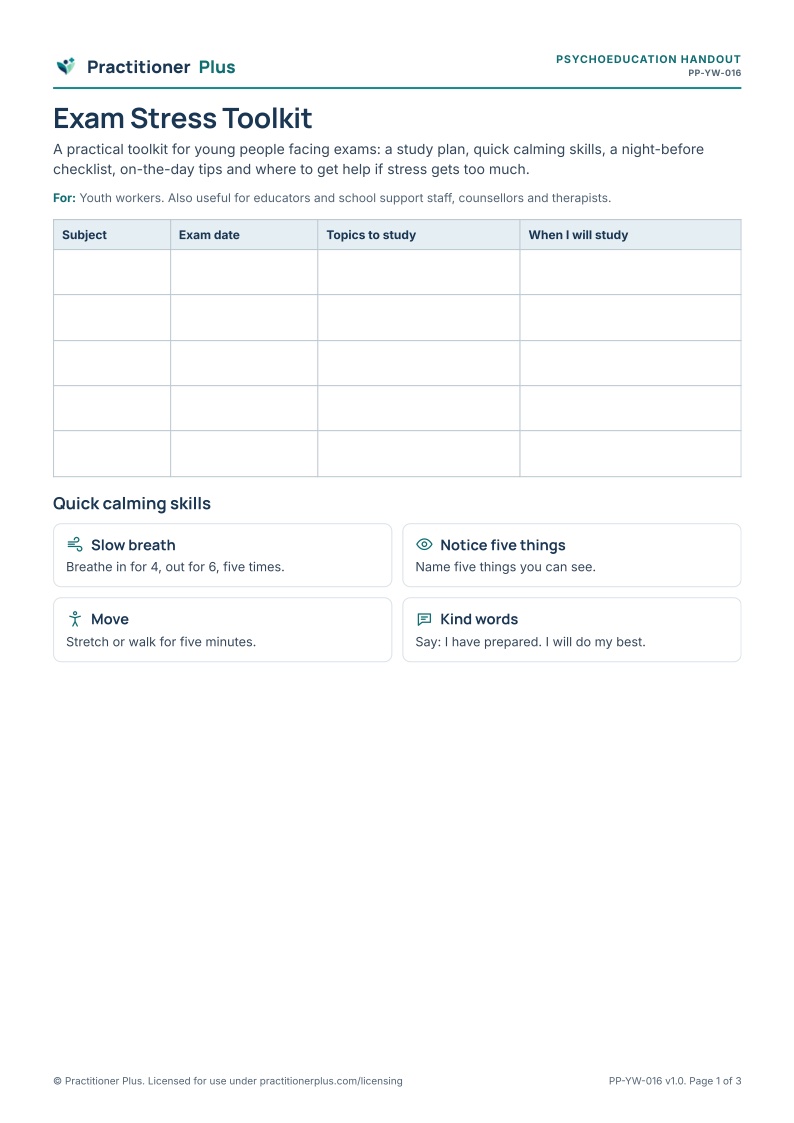
Some stress before exams is normal and can help focus. Too much makes it harder to think. This toolkit includes a simple study plan, quick calming skills, a night-before checklist, tips for the day and where to get help if stress becomes overwhelming.
Purpose
To give young people practical tools to manage study and exam stress.
Who it is for
Primary profession: Youth workers. Also relevant for educators and school support staff, counsellors and therapists.
Client or participant group: Secondary students and young people in further study.
Practice setting: Youth services, school wellbeing and study support programs.
Suggested uses
- Exam preparation sessions
- One-to-one wellbeing support
- Study groups
- School wellbeing programs
Instructions for practitioners
- Normalise exam stress.
- Help the young person make a realistic plan.
- Practise a calming skill together.
- Follow up if stress is affecting sleep, eating or mood over time.
Instructions for clients or participants
- Fill in your study plan.
- Practise a calming skill.
- Use the checklists before and on the day.
Accessibility considerations
Plain language. Can be shared digitally.
Scope and limitations
General information. It does not treat anxiety. Young people with ongoing distress should be supported to see a GP or counsellor.
Research basis
Practice testing and spaced study are among the most effective learning strategies, and self-regulated learning skills can be taught. Relaxation training, including breathing and muscle relaxation, reduces anxiety across a range of groups.
- Dunlosky, J., Rawson, K. A., Marsh, E. J., Nathan, M. J., & Willingham, D. T. (2013). Improving Students’ Learning With Effective Learning Techniques: Promising Directions From Cognitive and Educational Psychology. Psychological Science in the Public Interest, 14(1), 4–58. https://doi.org/10.1177/1529100612453266
- Manzoni, G. M., Pagnini, F., Castelnuovo, G., & Molinari, E. (2008). Relaxation training for anxiety: a ten-years systematic review with meta-analysis. BMC Psychiatry, 8(1), 41. https://doi.org/10.1186/1471-244x-8-41
- Zimmerman, B. J. (2002). Becoming a Self-Regulated Learner: An Overview. Theory Into Practice, 41(2), 64–70. https://doi.org/10.1207/s15430421tip4102_2
What is included
A 3-page printable A4 PDF, including a practitioner notes page with the research basis (version 1.0).
Originality
Original Practitioner Plus content: wording, activity structure, layout and icons were created for this resource. No third-party worksheets, illustrations or text were reproduced.


