
About this resource
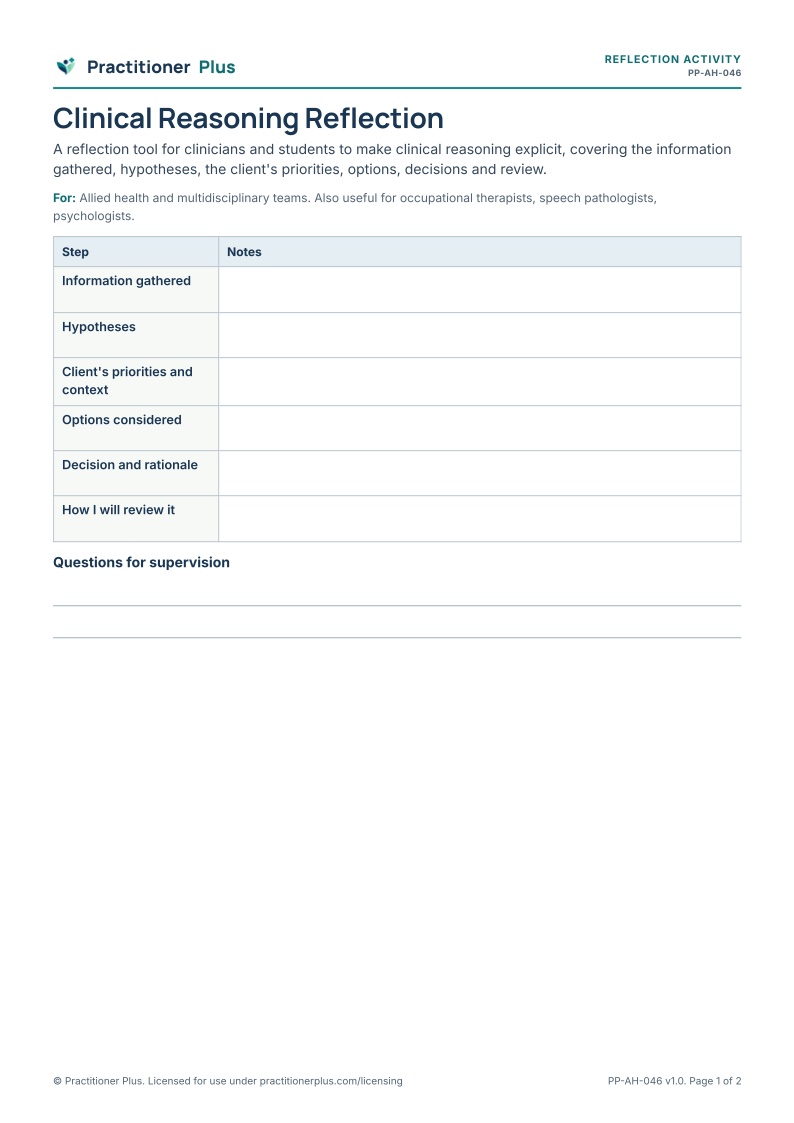
Good decisions come from explicit reasoning. This reflection walks through information gathered, hypotheses, the client's priorities and context, options considered, the decision and its rationale, and how it will be reviewed.
Purpose
To strengthen and articulate clinical reasoning.
Who it is for
Primary profession: Allied health and multidisciplinary teams. Also relevant for occupational therapists, speech pathologists, psychologists.
Client or participant group: Allied health clinicians and students.
Practice setting: Supervision, clinical education and complex cases.
Suggested uses
- Student supervision
- Complex cases
- Professional development
- Peer review
Instructions for practitioners
- Use with a de-identified case.
- Consider alternative hypotheses.
- Include the client's priorities.
- Discuss in supervision.
Accessibility considerations
Editable HTML source available for adaptation.
Scope and limitations
A reflection tool.
Research basis
Clinical supervision and structured reflection support learning, safe practice and professional development.
- Gibbs, G. (1988). Learning by doing: A guide to teaching and learning methods. Further Education Unit, Oxford Polytechnic. https://thoughtsmostlyaboutlearning.files.wordpress.com/2015/12/learning-by-doing-graham-gibbs.pdf
- Milne, D. (2007). An empirical definition of clinical supervision. British Journal of Clinical Psychology, 46(4), 437–447. https://doi.org/10.1348/014466507x197415
What is included
A 2-page printable A4 PDF, including a practitioner notes page with the research basis (version 1.0).
Originality
Original Practitioner Plus content: wording, activity structure, layout and icons were created for this resource. No third-party worksheets, illustrations or text were reproduced.


