
About this resource
This summary records the goal, the trial, alternatives and why an item is needed. Use the NDIA's current assistive technology templates where they are required.
Purpose
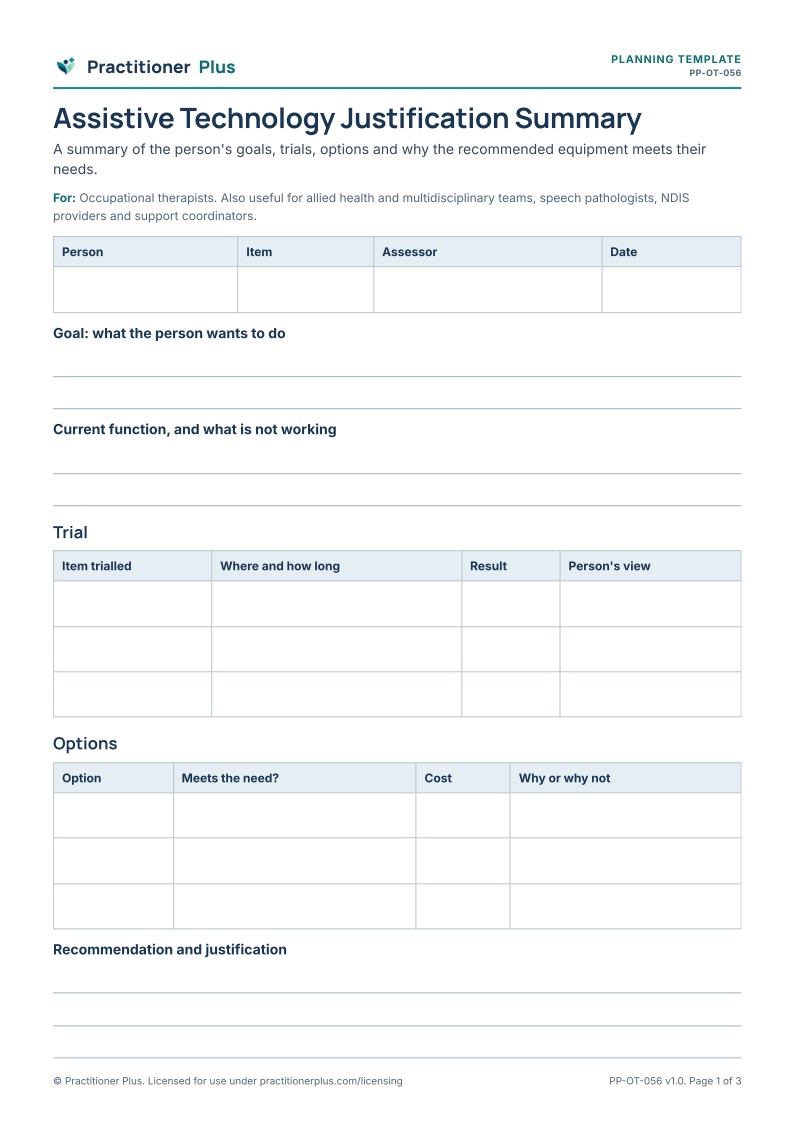
A summary of the person's goals, trials, options and why the recommended equipment meets their needs.
Who it is for
Primary profession: Occupational therapists. Also relevant for allied health and multidisciplinary teams, speech pathologists, NDIS providers and support coordinators.
Client or participant group: Occupational therapists and allied health practitioners.
Practice setting: Allied health practices.
Suggested uses
- AT requests
- NDIS reports
- Trial notes
Instructions for practitioners
- Add your details and delete what does not apply.
- Check it against your professional requirements.
- Explain it to the person in plain language.
- Store completed copies securely.
Accessibility considerations
Clear headings and tables. The Word version can be edited and filled in on screen.
Scope and limitations
A summary only. Follow your funder's current template.
Research basis
The NDIS looks at functional capacity in six areas: communication, social interaction, learning, mobility, self-care and self-management. Reports should describe functional impact, not just diagnosis.
- National Disability Insurance Agency. What is a functional capacity assessment. https://www.ndis.gov.au/applying/types-assessments/what-functional-capacity-assessment
What is included
A 3-page printable A4 PDF, including a practitioner notes page with the research basis (version 1.0).
Originality
Original Practitioner Plus content: wording, activity structure, layout and icons were created for this resource. No third-party worksheets, illustrations or text were reproduced. Written for Practitioner Plus from the sources in the research basis.


