
About this resource
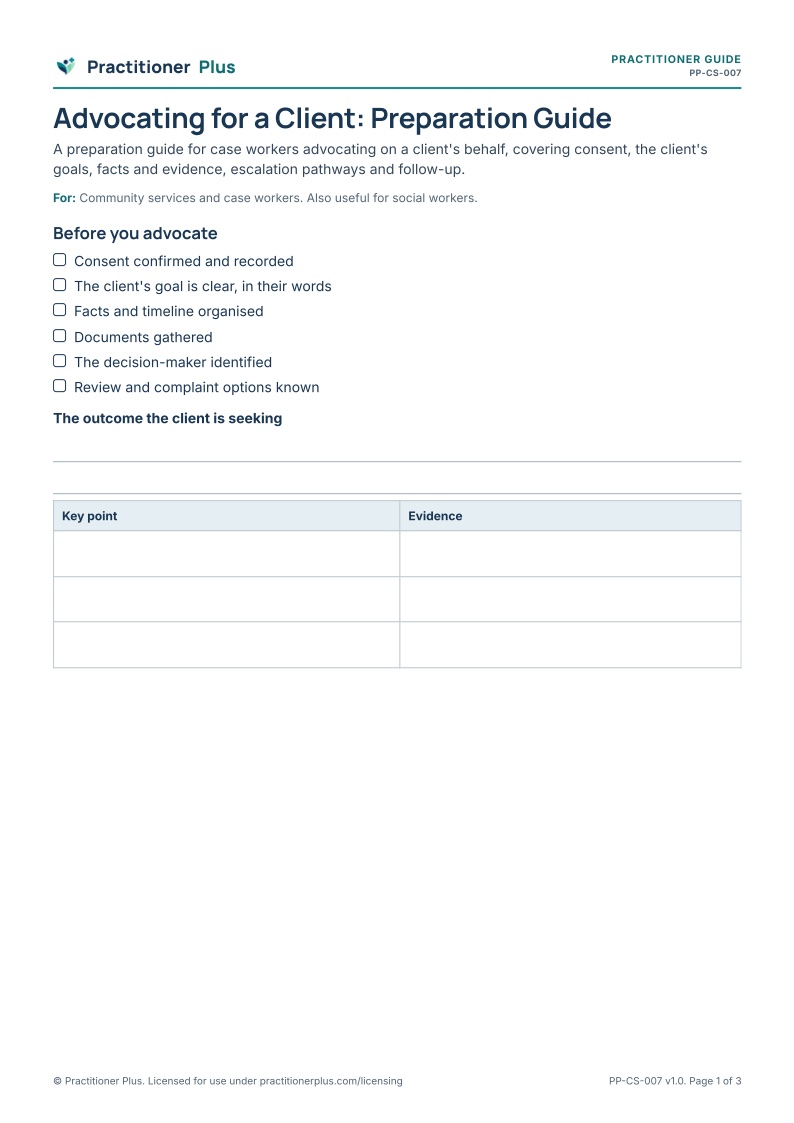
Effective advocacy is prepared advocacy. This guide helps case workers confirm consent and the client's goals, organise facts and evidence, plan the conversation, know the escalation pathways and keep the client informed, with a record of each contact.
Purpose
To make advocacy client-led, well-evidenced and effective, while keeping the client informed and in control.
Who it is for
Primary profession: Community services and case workers. Also relevant for social workers.
Client or participant group: Case workers advocating with agencies, landlords, services or decision-makers on behalf of a client.
Practice setting: Community services, homelessness, family support and other casework settings.
Suggested uses
- Advocating with agencies, landlords or services
- Preparing for a meeting or phone call on a client's behalf
- Escalating unresolved issues
- Supervising advocacy work
Instructions for practitioners
- Confirm consent and exactly what the client wants to achieve.
- Gather facts, documents and a clear timeline.
- Plan the key points and the outcome you are seeking.
- Know the review, complaint and escalation options.
- Report back to the client after every contact and record it.
Accessibility considerations
Keep the client involved in ways that suit them, including interpreters and plain-language updates.
Scope and limitations
A practice guide. It does not provide legal advice. Refer to legal services or specialist advocacy organisations where needed.
Research basis
Human rights frameworks and research on the dignity of risk support people's right to make their own choices, including choices that involve some risk. Case management practice standards describe assessment, planning, coordination, review and planned exits with the person at the centre.
- Case Management Society of Australia and New Zealand. (2013). National standards of practice for case management (3rd ed.). https://www.cmsa.org.au/
- Ibrahim, J. E., & Davis, M. (2013). Impediments to applying the ‘dignity of risk’ principle in residential aged care services. Australasian Journal on Ageing, 32(3), 188–193. https://doi.org/10.1111/ajag.12014
- United Nations. (2006). Convention on the Rights of Persons with Disabilities. https://www.ohchr.org/en/instruments-mechanisms/instruments/convention-rights-persons-disabilities
What is included
A 3-page printable A4 PDF, including a practitioner notes page with the research basis (version 1.0).
Originality
Original Practitioner Plus content: wording, activity structure, layout and icons were created for this resource. No third-party worksheets, illustrations or text were reproduced.


